
+How Advertisers Can Shape a Better Agency Pitch Process
Ten Tips to Nail Your Agency Pitch Process
With global uncertainty, pitches —global, regional, and local—have become increasingly competitive. With advances in technology, such as AI and constant moving of the goal posts when it comes to transparency and brand safety, Long-established agency/client relationships are being reassessed.
Advertisers are increasingly looking beyond their current agency partnerships for solutions that are better aligned with their brand needs. Some seek one-stop Holding Company solutions (this has dropped by 15 percentage points in the US since 2019*), while others prefer a collection of specialised shops to handle different elements of their marketing briefs. Some may appoint an intermediary or consultant to handle their pitch, whilst others will go it alone.
Whichever route you take, given the substantial time and resources each pitch requires, brands frequently ask, “What is the perfect pitch process, and how can we run one to get the most out of it and find the right long-term agency partner?”
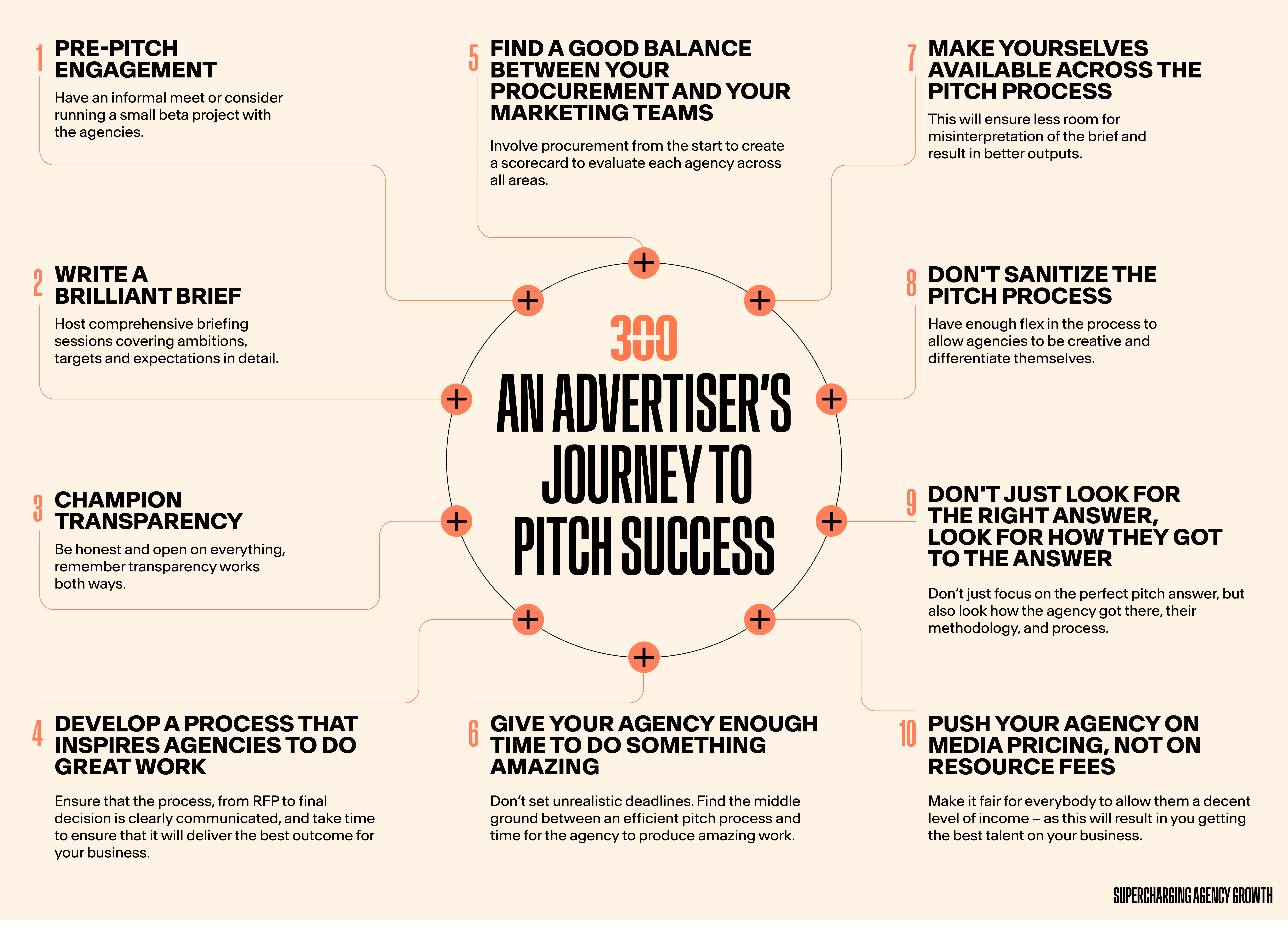
Although 300 primarily focuses on supercharging agency growth, our deep industry experience has given us valuable insights into what makes a well-executed pitch from a brand’s perspective. Here are our ten essential rules for crafting an effective agency selection process.
Rule 1 – Pre-Pitch Engagement
Before formally beginning the pitch process, meet potential agencies informally. Consider running a beta test through a small project. This preliminary engagement helps assess cultural fit and working dynamics without the pressure of a formal pitch environment.
Rule 2 – Write a brilliant brief
You will get the most from agency partners if they are as passionate about working on your business as you are. Host comprehensive briefing sessions that cover:
· Your brand’s essence and values
· Strategic ambitions and growth targets
· Agency partnership expectations
· Specific objectives for the pitch process
Rule 3 – Champion Transparency
Be honest and open with everything you say, transparency works both ways.
Transparency, is more than a buzzword, will foster a sense of common respect and an immediate bond. Hiding things from agencies won’t get the best from them as If they understand the parameters and pitfalls, they can deliver something beautiful. Remember, you are building a better, more collaborative, relationship for your business. Approach meetings as if you are ready to hire them. Be thoughtful and ask good questions – But most of all, be ready to walk away if the answers you receive during the process aren’t what you want to hear. A partnership is only good if expectations on both sides are in alignment.
Rule 4 – Develop a process that inspires agencies to do great work
Clearly define your contract of expectations and why you are committed to this process. A pitch that is badly put together is like a building with no foundations; it will collapse at some point. Take your
time to think through exactly what you need, ensure the process covers the most important areas to your business. but also, don’t include everything conceivable or it will become too big and cumbersome.
Rule 5 – Find a good balance between your procurement and your marketing teams
Marketing spend is often one of the biggest (and most contested) line items on a company’s balance sheet, necessitating the involvement of a procurement team. The procurement team is there to work closely with the marketing team to ensure the brand gets the best (talent, tech, op model, fees etc) at a fair price. Unfortunately, too many brands separate these two functions; often, the first part of a pitch is all about the marketing team finding the best agency to fulfil the strategic marketing goals. Then the brief is handed over to the procurement team to play agencies off against each other to try and get the lowest rate. Due to the huge sums of money involved, often the decision is to go with the cheapest agency, even if they are not going to achieve the best outcome for the client. This is because it’s easy to quantify savings and low costs, but it is much harder to look into the future and understand the benefits of what a brilliant agency is going to deliver. To be a true catalyst for change, you should involve the right stakeholders, including procurement, from the start of the process, agree on everyone’s responsibilities, and include a scorecard that helps evaluate an agency across multiple levels.
Rule 6 – Give your agency enough time to do something amazing
Setting unrealistic deadlines is going to make it hard for the agencies to do good work. Make sure you find the right balance between not having a long arduous process and making sure they have the time to think and produce the best work they can.
Rule 7 – Make yourselves available across the pitch process
Have a chemistry meeting, a Q&A session, and allow access to key decision-makers throughout the process. This will ensure less room for misinterpretation of the brief and better outputs from the agency and ultimate for yourselves!
Rule 8 – Don’t sanitize the pitch process
Allow your agencies to differentiate within the process. By all means, give them guardrails but don’t stifle their creativity through a super rigid process. In the Q&A part of the pitch, do not share agencies’ questions with other agencies; it will just stop them from asking the really smart ones as they won’t want to give away their thinking.
Rule 9 – Don’t just look for the right answer, look for how they got to the answer
Every agency will approach your brief in a different way, don’t just focus on the perfect pitch answer, but also look how they got there, the methodology, and process. No matter how much background work they do, they cannot fully get under the skin of your brand and your marketing function until they start to work with you. So look for the process, not just the answer, and how they measure up to the key areas of:
- Strategic methodology
- Problem-solving approach
- Team dynamics and chemistry
- Potential for long-term partnership
Rule 10 – Push your agency on media pricing, not on resource fees
Don’t squeeze your agency on fees, make it fair for everybody, and allow them to make a decent level of income. This will mean you will get the best talent on your business. Remember, they are a business too, and they have to make money.
Fair agency compensation ensures:
- Access to top talent
- Sustained quality of service
- Motivated agency teams
- Long-term partnership viability
We believe by following these ten rules, the process and outcomes of every pitch will change for the better.
However, if there was one piece of advice that would supersede all of these, it would be to hire a pitch consultant. These specialist consultants are experts in their field and will know how to craft, build, and manage pitches better than most advertisers will ever be able to do (sorry, clients!!!). They will be well worth the investment to ensure that you get the best from agencies and the best for your brand.
At 300, our primary focus is agency growth, but we also know what a pitch processes that inspire agencies to deliver their best work looks like.
*Source: e-marketer, The Ad Agency Ecosystem 2024